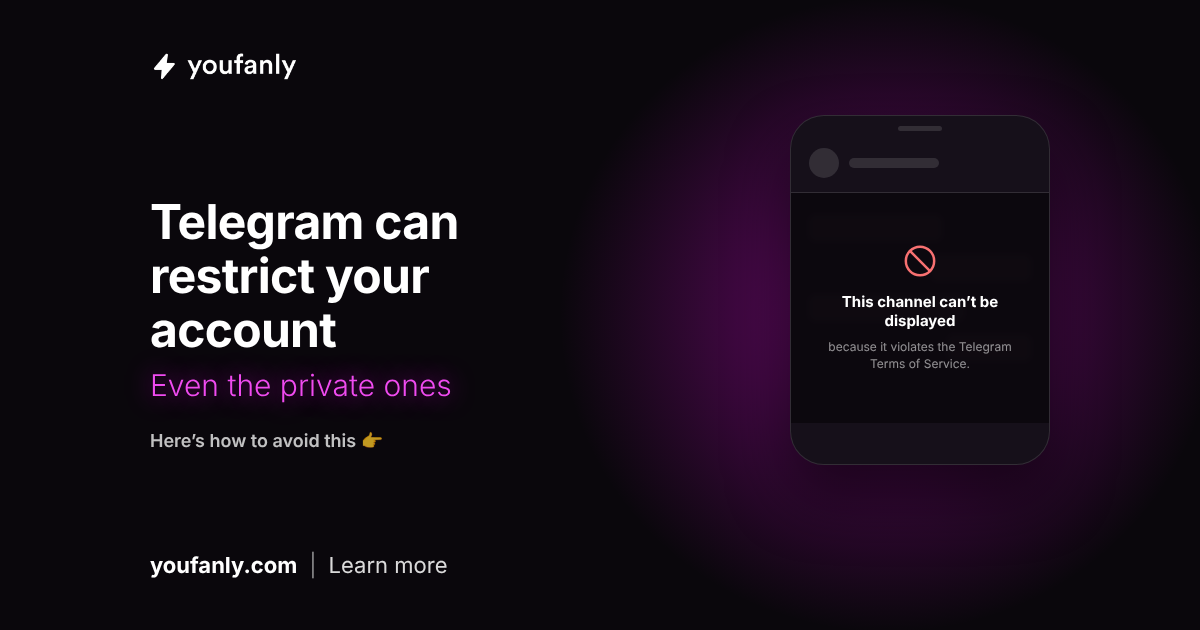
A creator runs a private, invite-only Telegram channel for two years. Paying members only, link shared one-on-one, nothing posted anywhere publicly. Then one morning the app shows a single line: this account has been limited. No warning, no specific reason, no way to reach a human. The payment links tied to that account stop working. The subscriber list, built message by message over two years, is gone the moment the account is gone with it.
“Private” feels like a shield. It isn’t one. Telegram enforces its own terms against any account it flags, whether the channel in question was ever searchable or not, and a creator running their business through it has no real recourse when that happens.
What Actually Triggers a Restriction
Telegram’s own Terms of Service prohibit sending spam, scamming users, and posting illegal pornographic content on publicly viewable channels and bots. The terms are broad on purpose, and enforcement doesn’t require a channel to be public for Telegram to act on a report or an automated flag. The same terms are blunt about what happens next: failure to comply “may result in a temporary or a permanent ban,” and a user who loses paid features like Premium as part of that ban isn’t compensated for it.
For a creator, the practical trigger is rarely a single dramatic post. It’s more often a cluster of ordinary creator behavior that a spam filter reads the wrong way: mass messages to subscribers, repeated payment links shared in chat, multiple people reporting the same account, or a sudden jump in message volume that looks automated even when a real person is sending it.
Private Doesn’t Mean Protected
Telegram tightened enforcement meaningfully after its founder’s 2024 arrest drew scrutiny over how the platform moderates illicit activity. An analysis from threat intelligence firm DarkOwl found that Telegram removed channels across several categories afterward, including ones tied to illicit content and copyright violations, while admitting it “was not clear about what type of content they considered to be illicit.” Telegram also revised its terms to share user IP addresses and phone numbers with authorities presenting valid legal requests, and quietly made certain channels and bots harder to surface in search, which the report describes as reduced visibility rather than an outright ban.
None of that enforcement distinguishes between a public channel with thousands of members and a private one with twelve. A private channel can still be reported by a member, flagged by an automated system scanning for prohibited content, or swept into a broader category Telegram decides to act on. Being invite-only reduces who can see the channel. It does nothing to change which rules apply to it.
Why a Banned Account Is Worse Than a Bad Month
A slow month on any platform is recoverable. A banned Telegram account is a different problem, because the account itself is the business. There’s no built-in way to export a subscriber list, no customer support line built for creators disputing an income-affecting ban, and per Telegram’s own terms, no compensation for whatever paid features or access were lost along with it. Everything a creator built, the relationships, the payment history, the message threads, lives inside an account that one flag can take offline with no appeal process guaranteed.
That risk sits underneath a workflow a lot of creators already find exhausting day to day. Manually tracking who paid, who still has access, and who needs a reminder is already a full-time job once a subscriber base grows past a handful of people, even before an account-level risk gets added on top of it.
Where Youfanly Is Actually Built Differently
Telegram is a messaging app that creators have adapted into a storefront. Youfanly is a platform built for that storefront to begin with, which changes what enforcement looks like. Subscription content and paid messaging are the actual business model here, not a side use case competing with spam and scam reports from an entirely different context.
That difference shows up directly in subscriber management. Every paying fan sits in one organized list, with access tracked automatically and auto-renewals handled without a creator manually checking who’s current. Mass messages go out to the whole list at once instead of scattered across individual chats, and losing access to the platform doesn’t mean losing access to a messaging app’s broader rules written for a completely different kind of user.
Reducing the Risk, Wherever You Post
- Never run the entire business out of a single account on a platform that wasn’t built for commerce
- Keep a subscriber contact method that doesn’t live entirely inside one app’s chat history
- Avoid patterns that read as automated to a spam filter, like identical mass messages sent in rapid bursts
- Treat a messaging app as a funnel to a dedicated platform, not as the platform itself
Frequently Asked Questions
Can a private, invite-only channel still get banned? Yes. Telegram’s terms apply regardless of whether a channel is public or private, and a report from a member or an automated flag can trigger enforcement either way.
Does Telegram explain exactly why an account was restricted? Often not in specific detail. Reporting on Telegram’s post-2024 enforcement found the company itself wasn’t consistently clear about what content or behavior it considered a violation in a given case.
Can a banned Telegram account be appealed? Telegram’s terms don’t guarantee an appeal process or any compensation for lost access or paid features, which is a meaningful difference from a platform built around paying creator accounts.
Does moving to Youfanly mean giving up Telegram entirely? No. Many creators keep a Telegram presence for casual updates while running the actual subscription business, payments, and subscriber management through a platform built for it.
Conclusion
A private channel feels safer than a public one, but it isn’t exempt from the rules of an app that was never designed to be a creator’s entire business. The account, the subscriber list, and the income all live under the same terms of service, and that service doesn’t owe a banned user compensation or an explanation.
Youfanly keeps subscriber management, messaging, and payouts inside a platform built around creators from the start, with no risk of a spam filter designed for an entirely different kind of app taking the whole business down at once. Become a creator and manage your subscribers somewhere that was actually built for it.
Leave a Reply