Blog

  • OnlyFans Chargebacks and Payout Holds: What They Actually Cost Creators

    OnlyFans Chargebacks and Payout Holds: What They Actually Cost Creators

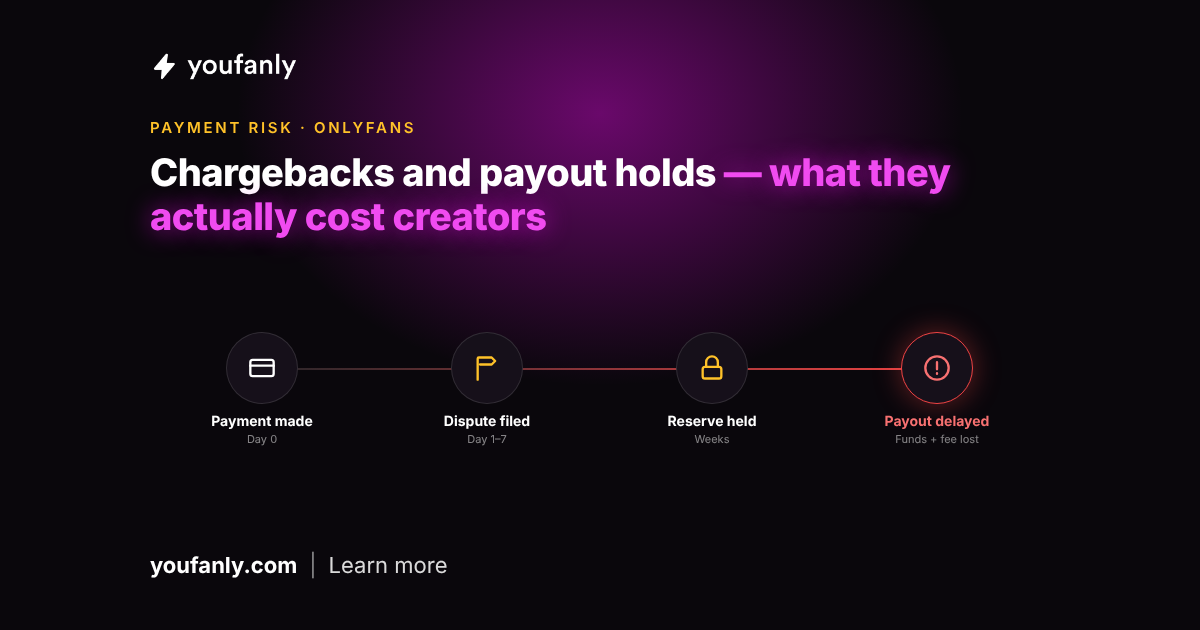
    A fan pays $15 for a locked video. It shows up in your balance the same day. Three weeks later, it’s gone, along with a flat dispute fee the platform deducts regardless of who’s at fault. Nobody warned you this could happen, and the money you’d already counted on for rent is simply not there anymore.

    This is what a chargeback does, and it’s one of the least talked-about risks of earning on a subscription platform. Searches for onlyfans chargeback get roughly a thousand a month, which tells you creators are running into this after the fact, not researching it before they pick a platform. Here’s what a chargeback actually is, how it’s different from a payout hold, and what to check before you build your income around any single platform.

    What a chargeback actually is

    A chargeback happens when a fan disputes a card payment directly with their bank instead of asking the platform for a refund. The bank reverses the charge, pulls the money back from the platform, and the platform usually deducts that amount from your balance. Many processors also charge a dispute fee on top, often somewhere between $15 and $100, and you pay it whether you win the dispute or not.

    Chargebacks aren’t always fraud. A lot of them are what processors call “friendly fraud”: a fan forgets they subscribed, doesn’t recognize the charge description on their statement, or disputes a tip they sent on purpose and later regrets. None of that makes the chargeback less real for you. The money still leaves your balance.

    A chargeback is not the same as a payout hold

    A payout hold delays your money. A chargeback takes it away. Platforms that route payments through a card processor will often sit on a percentage of every creator’s balance for a set period, called a reserve, specifically so they have something to claw back if a dispute lands later. Stripe’s own documentation on reserves describes holds that can run anywhere from a rolling few days up to 90 days, depending on the account’s risk profile and payment history.

    That distinction matters because the two risks stack. A new or fast-growing creator account can get hit with a longer reserve at the exact moment they’re also at higher risk of disputes, since large, sudden spikes in sales are one of the signals processors watch for.

    Why adult platforms see this more than most

    Subscription and tipping platforms for adult content are considered higher-risk merchants by card networks, which means the reserve and dispute terms tend to be stricter than on a typical e-commerce site. Creators comparing OnlyFans alternatives on fees and payout speed often find that the headline commission isn’t the whole story: a platform can advertise an 80/20 split and still leave you waiting days for a payout review, or holding back a percentage of your balance against future disputes.

    Some platforms publish their dispute terms clearly: a stated pending period before a sale becomes withdrawable, a defined reserve percentage, and conditions under which they’ll absorb a chargeback versus pass it straight to the creator. Others leave this vague, which means you only find out the real policy the first time you’re disputed against.

    For a creator in Lagos, Nairobi, or Accra, a reserve or a chargeback hits twice as hard. First the platform holds the money, then whatever’s left has to clear an international payout, a currency conversion, and often a second account just to get it into local currency. A hold that’s a minor inconvenience for a creator in a country where the platform pays out directly in local currency can quietly turn into a multi-week wait once you add a wire transfer and a conversion on top.

    How Youfanly handles payouts differently

    Youfanly withdrawals are approved and processed within 24 to 48 hours of your request, and once approved, the money usually lands in your bank account, mobile money wallet, or crypto wallet within minutes. There’s no multi-week rolling reserve sitting on top of your balance by default, and creators keep 100% of tips rather than a percentage cut disappearing before the money is even theirs. You can see the full breakdown of how Youfanly’s payout model compares to other creator platforms if you want the full picture before you move your income over.

    That speed matters most in the first few months, when a single held payout can be the difference between reinvesting in content and falling behind. If you’re still mapping out what realistic monthly income looks like as you’re getting started, this breakdown of what adult content creators actually earn walks through a realistic income timeline alongside the payout math.

    What to check before you rely on any platform for income

    • Payout schedule. How many days does a sale sit before it’s actually withdrawable, not just “earned”?
    • Reserve policy. Does the platform hold back a percentage of every sale, and for how long?
    • Chargeback responsibility. Does the platform absorb disputes, deduct them straight from your balance, or something in between?
    • Appeal process. If you think a chargeback or hold was wrong, is there an actual process to contest it, with a stated deadline?
    • Account-freeze terms. What specifically triggers a full review, and can you still withdraw undisputed funds while one is happening?

    A platform with a slightly lower revenue share but clear, short reserve terms is often a better deal than one advertising the biggest cut for creators and saying nothing about how long your money actually takes to become yours.

    FAQ

    Does a chargeback mean I lose the money permanently?

    Usually, yes, unless the platform has a dispute process and you successfully contest it with evidence, like proof the fan accessed the content. Even a successful dispute can still cost you the processor’s chargeback fee.

    What’s the real difference between a hold and a chargeback?

    A hold delays money you’ve already earned. A chargeback removes money after it’s been reversed by the fan’s bank. A platform can do both to the same sale: hold it for a review period, then still claw it back later if a dispute comes in during that window.

    Can Youfanly creators still get hit with a chargeback?

    Card-based disputes are a risk on any platform that accepts card payments, Youfanly included. The difference is what happens around it: Youfanly doesn’t sit on your whole balance under a long rolling reserve by default, so a dispute doesn’t also come with weeks of frozen, undisputed earnings on top.

    How fast can I actually withdraw on Youfanly?

    Withdrawal requests are approved and processed within 24 to 48 hours, and once approved, funds typically arrive in your bank account, mobile money wallet, or crypto wallet within minutes.

    Picking a platform on commission rate alone is how creators end up surprised by a hold or a dispute they never saw coming. If fast, predictable payouts matter more to you than a slightly bigger headline percentage, Youfanly is built around getting your money to you quickly and telling you exactly where it stands.
  • UK Porn Ban 2026: What’s Actually Illegal and What It Means for Creators

    UK Porn Ban 2026: What’s Actually Illegal and What It Means for Creators

    By the morning of November 6, 2026, Sophia Truee had lost 392 of the 506 clips she had listed on Clips4Sale. Nothing about her account had changed overnight. What changed was the law: the UK’s Crime and Policing Act 2026 took effect that day, and Clips4Sale responded by automatically hiding the large majority of her catalog pending manual review.

    If you post adult content anywhere, this is worth understanding properly, because what’s actually illegal under the new rules is narrower than what’s happening to creators’ accounts right now. Here’s what the law covers, how different platforms are responding, and what’s worth checking in your own content library before a bot does it for you.

    What the law actually bans

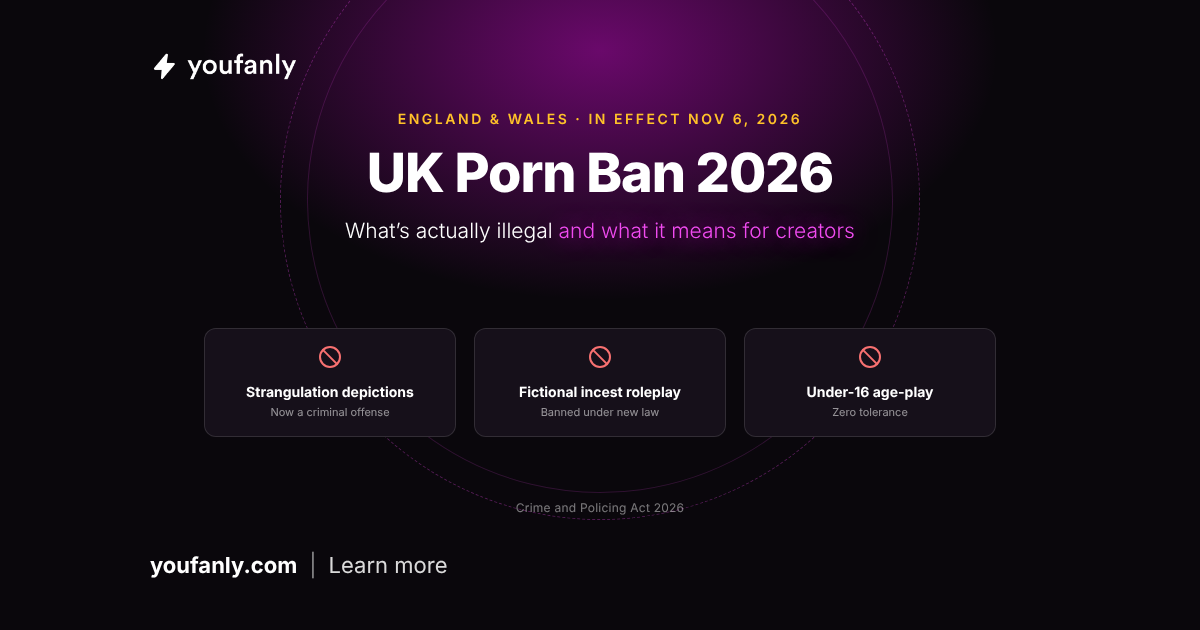
    The Crime and Policing Act 2026 makes it a criminal offense in England and Wales to possess or publish pornographic images that realistically depict one of three things, as long as the people shown appear real to a reasonable viewer, according to the government’s own guidance:

    • Strangulation or suffocation
    • Penetrative sex between close relatives, including certain step and foster-family pairings where someone is, or is pretending to be, under 18
    • Sexual activity where at least one person is, or is pretending to be, under 16

    It is not a ban on adult content, kink, or roleplay generally. Possessing banned material carries up to two years in prison (three years for the under-16 category), and publishing any of the three categories carries up to five years. Platforms have their own exposure too: Ofcom can fine a company up to £18 million or 10% of its global revenue, whichever is higher, if it fails its duties under the Online Safety Act. The guidance also builds in a few defenses, including for an image you never requested and didn’t keep, or one you appear in yourself.

    Why platforms are removing far more than the law requires

    The law covers three specific categories. What creators are actually experiencing is broader. On November 5, Clips4Sale emailed creators warning it would review not just videos but titles, tags, and descriptions, then started auto-hiding clips the next morning. Creators reported losing the majority of their catalogs with no specifics on which clips were flagged or why, support calling it “a precautionary measure.” LoyalFans went further, updating its terms to ban strangulation or suffocation content even when it’s clearly simulated or fantasy, and removing content some creators had kept live for years. JustForFans took a narrower approach: it flags new uploads, restricts them only for UK viewers, and gives creators a way to edit, replace, or challenge a flag rather than losing the content outright.

    The difference matters because it isn’t really about the law anymore; it’s about how much risk a platform is willing to absorb versus pass straight on to you. A platform that over-removes to protect itself from a fine is making a business decision, not following a legal requirement, and the timing, days before Black Friday, one of the biggest sales periods of the year for adult creators, made sure the cost of that decision landed squarely on creators’ income.

    What to actually check in your own content

    • Go through your own back catalog against the three categories above, rather than waiting for a platform’s automated scan to do it for you and guess at the reason afterward.
    • Possession counts, not just publishing. Delete anything that fits one of the three categories from your own devices and cloud storage too, not just from the platform itself.
    • “Fantasy” or roleplay framing doesn’t exempt content on its own. The test is how the image appears to a reasonable viewer, not what was actually true on set.
    • If a platform removes something you’re confident doesn’t fit any category, ask for the specific reason rather than accepting a blanket “precautionary” explanation with nothing else behind it.

    Why platform choice matters here too

    This is the second major compliance shift creators have had to absorb in under a month, after the UK, US, and French regulators all moved on age verification. Neither is going away, and more will follow. What’s actually in your control is which platform you build on, and whether that platform treats a compliance update as a reason to communicate clearly or as a reason to quietly delete first and explain later. A platform worth staying on tells you specifically what changed and why, instead of leaving you to guess which third of your catalog survived the week.

    FAQ

    Does this only apply if I’m based in the UK?
    No. The offenses cover possessing or publishing the content in England and Wales, so they apply to UK viewers and UK-based platforms regardless of where a creator lives. Scotland and Northern Ireland have their own separate provisions. A platform can also choose to apply a new policy globally, as LoyalFans did, even though the law itself is UK-specific.

    Does roleplay count if nobody involved is actually related or underage?
    Potentially, yes. The law covers how the content appears to a reasonable viewer, not what was actually true during filming. That’s the main reason platforms are erring on the side of removing content rather than trying to verify intent case by case.

    Will I lose my whole account, or just the flagged content?
    Based on current reporting, platforms are removing or restricting specific content rather than banning accounts outright. JustForFans’ approach, flagging items for review instead of deleting them automatically, is the more forgiving model so far.

    Is this legal advice?
    No. This is a summary of public guidance and reporting, not legal advice for your specific content or situation. If you’re unsure whether something you’ve posted could fall into one of these categories, talk to a solicitor who handles this area, not a platform’s support team.

    Become a creator on Youfanly

    Compliance rules are changing fast, and the platforms that survive it are the ones that tell creators exactly what’s happening to their content, not the ones that delete first and explain later. Become a creator on Youfanly and get clear, predictable communication about anything that affects your content or your balance.

  • Telegram Can Restrict Your Account. Even the Private Ones.

    Telegram Can Restrict Your Account. Even the Private Ones.

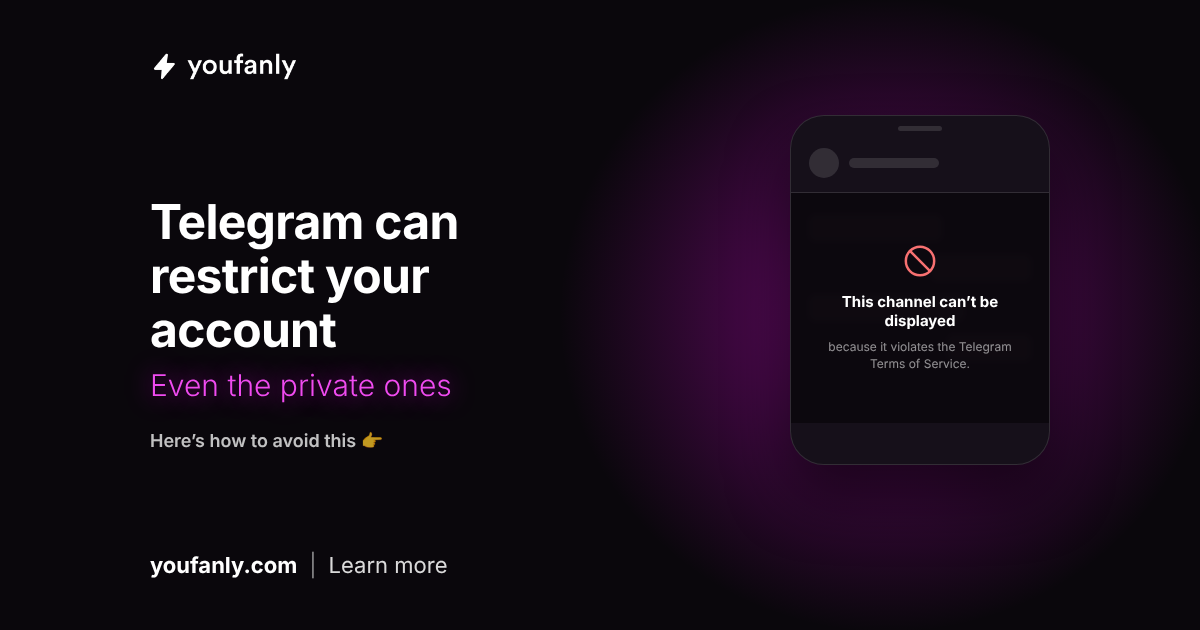
    A creator runs a private, invite-only Telegram channel for two years. Paying members only, link shared one-on-one, nothing posted anywhere publicly. Then one morning the app shows a single line: this account has been limited. No warning, no specific reason, no way to reach a human. The payment links tied to that account stop working. The subscriber list, built message by message over two years, is gone the moment the account is gone with it.

    “Private” feels like a shield. It isn’t one. Telegram enforces its own terms against any account it flags, whether the channel in question was ever searchable or not, and a creator running their business through it has no real recourse when that happens.

    What Actually Triggers a Restriction

    Telegram’s own Terms of Service prohibit sending spam, scamming users, and posting illegal pornographic content on publicly viewable channels and bots. The terms are broad on purpose, and enforcement doesn’t require a channel to be public for Telegram to act on a report or an automated flag. The same terms are blunt about what happens next: failure to comply “may result in a temporary or a permanent ban,” and a user who loses paid features like Premium as part of that ban isn’t compensated for it.

    For a creator, the practical trigger is rarely a single dramatic post. It’s more often a cluster of ordinary creator behavior that a spam filter reads the wrong way: mass messages to subscribers, repeated payment links shared in chat, multiple people reporting the same account, or a sudden jump in message volume that looks automated even when a real person is sending it.

    Private Doesn’t Mean Protected

    Telegram tightened enforcement meaningfully after its founder’s 2024 arrest drew scrutiny over how the platform moderates illicit activity. An analysis from threat intelligence firm DarkOwl found that Telegram removed channels across several categories afterward, including ones tied to illicit content and copyright violations, while admitting it “was not clear about what type of content they considered to be illicit.” Telegram also revised its terms to share user IP addresses and phone numbers with authorities presenting valid legal requests, and quietly made certain channels and bots harder to surface in search, which the report describes as reduced visibility rather than an outright ban.

    None of that enforcement distinguishes between a public channel with thousands of members and a private one with twelve. A private channel can still be reported by a member, flagged by an automated system scanning for prohibited content, or swept into a broader category Telegram decides to act on. Being invite-only reduces who can see the channel. It does nothing to change which rules apply to it.

    Why a Banned Account Is Worse Than a Bad Month

    A slow month on any platform is recoverable. A banned Telegram account is a different problem, because the account itself is the business. There’s no built-in way to export a subscriber list, no customer support line built for creators disputing an income-affecting ban, and per Telegram’s own terms, no compensation for whatever paid features or access were lost along with it. Everything a creator built, the relationships, the payment history, the message threads, lives inside an account that one flag can take offline with no appeal process guaranteed.

    That risk sits underneath a workflow a lot of creators already find exhausting day to day. Manually tracking who paid, who still has access, and who needs a reminder is already a full-time job once a subscriber base grows past a handful of people, even before an account-level risk gets added on top of it.

    Where Youfanly Is Actually Built Differently

    Telegram is a messaging app that creators have adapted into a storefront. Youfanly is a platform built for that storefront to begin with, which changes what enforcement looks like. Subscription content and paid messaging are the actual business model here, not a side use case competing with spam and scam reports from an entirely different context.

    That difference shows up directly in subscriber management. Every paying fan sits in one organized list, with access tracked automatically and auto-renewals handled without a creator manually checking who’s current. Mass messages go out to the whole list at once instead of scattered across individual chats, and losing access to the platform doesn’t mean losing access to a messaging app’s broader rules written for a completely different kind of user.

    Reducing the Risk, Wherever You Post

    • Never run the entire business out of a single account on a platform that wasn’t built for commerce
    • Keep a subscriber contact method that doesn’t live entirely inside one app’s chat history
    • Avoid patterns that read as automated to a spam filter, like identical mass messages sent in rapid bursts
    • Treat a messaging app as a funnel to a dedicated platform, not as the platform itself

    Frequently Asked Questions

    Can a private, invite-only channel still get banned? Yes. Telegram’s terms apply regardless of whether a channel is public or private, and a report from a member or an automated flag can trigger enforcement either way.

    Does Telegram explain exactly why an account was restricted? Often not in specific detail. Reporting on Telegram’s post-2024 enforcement found the company itself wasn’t consistently clear about what content or behavior it considered a violation in a given case.

    Can a banned Telegram account be appealed? Telegram’s terms don’t guarantee an appeal process or any compensation for lost access or paid features, which is a meaningful difference from a platform built around paying creator accounts.

    Does moving to Youfanly mean giving up Telegram entirely? No. Many creators keep a Telegram presence for casual updates while running the actual subscription business, payments, and subscriber management through a platform built for it.

    Conclusion

    A private channel feels safer than a public one, but it isn’t exempt from the rules of an app that was never designed to be a creator’s entire business. The account, the subscriber list, and the income all live under the same terms of service, and that service doesn’t owe a banned user compensation or an explanation.

    Youfanly keeps subscriber management, messaging, and payouts inside a platform built around creators from the start, with no risk of a spam filter designed for an entirely different kind of app taking the whole business down at once. Become a creator and manage your subscribers somewhere that was actually built for it.

  • Your Content Got Leaked. Here’s What to Actually Do.

    Your Content Got Leaked. Here’s What to Actually Do.

    A creator searches her own username one slow Tuesday night and finds forty of her paid photos sitting on a free tube site, stripped of the watermark, with a comment thread arguing about whether more is coming. She never posted them there. Someone who paid for them did, or someone screen-recorded a stream and uploaded the file. Either way, the content she sells for a living is now free, and she has no idea what to do next.

    This happens constantly in the creator economy, and almost no platform walks new creators through what their actual options are. Leaked content isn’t just annoying. It’s a direct hit to income, and in many cases it’s a straightforward legal violation with a real, specific process for fixing it.

    Your Content Is Still Yours, Even After Someone Else Posts It

    The moment a creator shoots a photo or video, they own the copyright in it, automatically, with no registration required. A fan paying for access to that content buys a license to view it, not ownership of it and not the right to repost it anywhere else. Reposting it on a tube site, a forum, or a Telegram channel is copyright infringement, full stop, regardless of how the original access was obtained.

    That ownership is what gives a creator legal standing to get the content removed. The U.S. Copyright Office’s own guidance on Section 512 of the DMCA lays out exactly how that removal process works, and it’s built to be usable without a lawyer.

    How a DMCA Takedown Notice Actually Works

    A DMCA takedown notice is a formal request sent to the site or host where the stolen content is living, asking them to remove it. Under Section 512, a valid notice needs six things: a signature (an email sign-off counts), identification of the copyrighted work, identification of where the infringing copy is posted (a direct URL is ideal), contact information for the copyright owner, a statement that the use wasn’t authorized, and a statement under penalty of perjury that the sender is the rights holder or authorized to act for them.

    No registration with the Copyright Office is required before sending one. Most legitimate hosting companies, from mainstream site hosts down to smaller tube sites that want to keep their own hosting providers happy, have a designated DMCA contact and will act on a properly formatted notice because ignoring it puts their own safe harbor protection at risk. A notice that’s missing pieces or vague about the URL is the single most common reason a request gets ignored, so specificity matters more than tone.

    The Law That Shortened the Timeline

    DMCA notices can still take days or weeks to resolve depending on how responsive a host is. A newer federal law changes that math for a specific category of content. The FTC’s summary of the TAKE IT DOWN Act explains that covered platforms, meaning social media, messaging, and image or video sharing services, must now give people a clear process to request removal of intimate images shared without consent, and must take down the content and any known identical copies within 48 hours of a valid request.

    The law covers real photos and videos as well as AI-generated or altered “digital forgeries,” which matters as deepfake tools get more convincing. Platforms that don’t comply can face FTC enforcement and civil penalties per violation. For a creator dealing with a leak on a platform that falls under this law, citing it directly in a removal request, alongside or instead of a DMCA notice, gives a much faster deadline to point to.

    Finding Leaks Before a Fan Sends a Screenshot

    Most creators find out about a leak the hard way: a fan messages them a link, or they stumble across it by accident. A regular reverse image search on a handful of recent paid posts, done monthly, catches most reposts early, while the file is still only on one or two sites instead of forty. Watermarking every piece of paid content, including paid DMs, with something small and hard to crop out makes a leaked file easier to trace back to its source and easier to prove ownership of later.

    This matters just as much for one-off paid messages as it does for subscription content. How paid DMs actually work and what they pay covers the mechanics of that side of the business, and the same content ends up in the same leak pipelines as subscription posts once it leaves a creator’s hands.

    Habits That Make a Leak Easier to Fight

    • Keep dated originals and proof of authorship for paid content, including the raw file before any watermark or edit
    • Watermark exports consistently, even for single paid messages, not just subscription posts
    • Run a reverse image search on a few recent posts on a regular schedule instead of waiting for a fan to flag it
    • Report leaks to the platform hosting them directly, not just to search engines, since removal from a host stops new copies from spreading

    None of this requires turning content creation into a part-time security job. It’s closer to the same basic upkeep that protects any other source of income, applied to a business where the product happens to be digital and easy to copy.

    Frequently Asked Questions

    Do I need a lawyer to send a DMCA takedown? No. The Copyright Office’s own process is designed to be usable directly by the copyright owner, with no registration or legal representation required, though a lawyer can help with a site that keeps ignoring valid notices.

    What if the site hosting my content is outside the US? DMCA notices are routinely honored by hosts worldwide because most major hosting providers and ad networks are US-based or want to stay compliant with US law, but enforcement against a site with no cooperative host anywhere in its chain is harder and may call for reporting it to the platform where it’s being shared instead.

    Does any of this apply if the leaked content is an AI-made fake, not something I actually filmed? Yes. The TAKE IT DOWN Act specifically covers AI-generated and altered “digital forgeries” alongside real images, so a deepfake made to look like a creator is covered by the same 48 hour removal requirement on platforms subject to the law.

    What happens if a platform just ignores my takedown request? A platform that repeatedly ignores valid DMCA notices risks losing its own safe harbor protection, and one that ignores a valid TAKE IT DOWN Act request can face FTC enforcement and civil penalties, so persistence and a clear paper trail of each request sent genuinely matters.

    Conclusion

    A leak isn’t a reason to assume the content is just gone for good or that nothing can be done about it. Between a standard DMCA notice and the newer, faster removal path under the TAKE IT DOWN Act, creators have real, specific tools for getting stolen content down, and watermarking plus a regular search habit catches most leaks long before they spread.

    On Youfanly, paid posts and DMs stay behind the platform’s own access controls, and creators keep 70 percent of subscription revenue and 100 percent of every tip and paid message they actually get paid for. Become a creator and build on a platform built around protecting that income, not just collecting it.

  • How Creator Payouts Actually Work (and Why the Money Isn’t Instant)

    How Creator Payouts Actually Work (and Why the Money Isn’t Instant)

    A creator hits withdraw on a $340 balance and watches the screen say “pending.” No explanation, no countdown, just a status that sits there. The money was clearly earned. It just isn’t available yet, and almost nobody explains why before a creator signs up to a platform in the first place.

    Payout mechanics are one of the least talked about parts of creator platforms, and one of the most important. Subscriptions, tips, and paid messages get all the attention because they’re the fun part. What happens between “earned” and “in my bank account” is where creators actually judge whether a platform respects their time.

    Payout Day Isn’t the Same as Earning Day

    Almost every creator platform separates the moment money is earned from the moment it becomes withdrawable. A tip sent today usually shows up as a pending balance first, then moves into an available balance on a fixed schedule, commonly weekly. This isn’t a platform being slow on purpose. It’s standard in how online marketplaces move money, and it exists for a specific reason: refunds and chargebacks.

    If a fan disputes a charge with their bank, the platform needs to be able to reverse that payment before it’s already out the door to a creator. Holding newly earned money for a short window, then releasing it, is how platforms protect themselves from paying out money that gets clawed back days later. Stripe, which powers payouts for a large share of online marketplaces, documents this directly: new or higher-risk accounts often have a portion of their balance held in reserve specifically to cover exactly this kind of dispute.

    Why Verification Keeps Coming Back

    Identity verification, usually called KYC (know your customer), tends to feel like a one-time hurdle at signup. In practice, a lot of platforms re-check it when a creator’s earnings jump, when a new payout method gets added, or at random intervals tied to the platform’s own compliance rules. This isn’t about distrust of any individual creator. It’s a requirement that exists across the payments industry, not something a single platform invented to slow creators down.

    Payment processors and the banks behind them are legally required to confirm who they’re sending money to, the same way a bank asks for ID to open an account. Chainalysis, a firm that works on payments compliance, describes KYC as a standard check that applies across banking, crypto, and online payment platforms alike, not a red flag specific to adult content or creator platforms.

    The Payout Method Changes More Than People Expect

    How a creator chooses to get paid affects speed, fees, and sometimes whether the money is usable at all. A bank transfer is familiar but can take a few business days to clear, especially across borders. Crypto can move faster but asks a creator to already be comfortable managing a wallet. Mobile money is often the fastest and most practical option for creators in markets where it’s the default way people move money day to day, but plenty of global platforms don’t support it at all, forcing creators through a separate e-wallet or a bank account they don’t actually use.

    That gap shows up hardest for creators outside the US and Europe. The specific hurdles creators across Africa run into when a platform only supports one or two payout rails are a good example of how much the payout method itself can determine whether a platform is actually usable, regardless of how good the content or the audience is.

    What Actually Determines Take-Home Pay

    Payout schedules and methods only matter once there’s money to pay out, and that depends on the platform’s cut. A platform that advertises a high headline earning potential but takes a large percentage, or treats tips and paid messages differently from subscriptions, can leave a creator with far less than expected. What creators actually keep after a platform’s cut varies more than most people assume, which is exactly why the percentage matters as much as the audience size.

    On Youfanly, creators keep 70 percent of subscription revenue and 100 percent of every tip and paid message, with no separate e-wallet required to withdraw. A creator can see exactly what’s pending, what’s available, and what the conversion rate is before choosing to withdraw to a bank account, mobile money, or crypto.

    A Few Habits That Make Payouts Less Stressful

    • Complete identity verification fully the first time, rather than partially, to avoid a second request later
    • Check a platform’s payout schedule and minimum withdrawal amount before relying on it as a primary income source
    • Pick a payout method based on what’s actually usable where you live, not just what’s listed first
    • Keep payout confirmations and statements, since they double as the records needed for tax reporting

    Frequently Asked Questions

    Why isn’t my balance available to withdraw right away? Most platforms hold newly earned money for a short period before it becomes available, mainly to cover potential refunds or disputed charges. This is standard across online marketplaces, not specific to any one platform.

    Why do I have to verify my identity again? Platforms sometimes re-run identity checks when earnings increase, a new payout method is added, or as part of routine compliance. It’s a payments industry requirement, not a sign anything is wrong with an account.

    Which payout method is fastest? It depends on the platform and the creator’s location. Mobile money is often fastest where it’s widely used, crypto can be quick but requires wallet management, and bank transfers are familiar but can take a few business days, especially internationally.

    Does the payout method affect how much I actually receive? It can. Some methods carry conversion costs or third-party fees depending on the destination, so the percentage a platform advertises isn’t always the full picture of what lands in an account.

    Conclusion

    Payout mechanics rarely get marketed, but they decide whether a platform is actually usable for the person earning on it. A fair percentage means little if the money can’t reach a creator’s bank account, mobile money wallet, or crypto wallet without friction.

    On Youfanly, creators see their available balance clearly and withdraw straight to a bank account, mobile money, or crypto, no separate e-wallet required. Become a creator on Youfanly and get paid the way that actually works for you.

  • Inside Accra’s Nightlife: Ghana’s After-Dark Creator Economy

    Inside Accra’s Nightlife: Ghana’s After-Dark Creator Economy

    By 11pm on a Friday, Oxford Street in Osu is already louder than most cities get at midnight. Bars spill their music onto the sidewalk, vendors grill kebab and waakye under string lights, and a line of taxis and ride-hail cars idles outside every entrance waiting for the next move. This strip has been Accra’s main nightlife artery for years, and in 2026 the rest of the world finally started paying attention to it.

    Time Out’s 2026 global nightlife ranking placed Accra 18th out of the world’s twenty best cities to go out in, one of only two African cities on the list alongside Johannesburg, which came in seventh. The survey drew on more than 24,000 locals, and Accra scored especially high on the things that are hardest to fake: 62 percent of residents called going out affordable, 75 percent said it was easy to find community, and 65 percent described the city as welcoming. That is not a tourism board talking. That is the city’s own nightlife crowd.

    Where Accra Goes After Dark

    Osu remains the center of gravity, and Oxford Street specifically is where most first nights out in Accra happen. It is dense, walkable, and built for bouncing between a bar, a lounge, and a late-night food stall without ever moving your car. East Legon has grown into the second major scene, quieter and more upscale, the kind of neighborhood where a rooftop lounge and a members-style club sit a few streets apart from each other.

    Then there is the beach. Labadi, often just called La, turns into one of the city’s biggest party scenes on weekends, where a daytime beach hangout slides straight into a night event without ever really ending. The music underneath all of it has grown well past the Afrobeats everyone expects. Hiplife and highlife are still the local backbone, azonto never really left the dance floor, and amapiano has worked its way into Accra DJ sets the same way it has across West Africa. Time Out specifically called out Accra’s growing mix of electronic music, alté, and R&B spaces alongside the mainstream clubs, which is part of why the scene reads as more varied than a single genre or a single strip of bars.

    December in Ghana, Not “Detty December”

    Every December, Accra’s nightlife multiplies. More than 125,000 international visitors arrived last December alone, more than any other month, continuing a three-year trend of the diaspora flying home for the season. Concerts stack on top of each other, beach parties run for days, and Oxford Street barely has room to move.

    What makes this genuinely specific to Ghana right now is the tension playing out over what to call it. Nigeria popularized “Detty December” for the same seasonal wave, and Ghana’s government has made a point of not adopting the phrase. Officials have said plainly that the term carries associations they do not want tied to the country’s image, and the preferred branding is simply “December in Ghana,” with one government official even floating a shortened “D-I-G” as an alternative. Young Ghanaians use “Detty December” anyway, because that is what the season actually feels like on the ground, and the gap between the official messaging and the lived experience is its own small piece of culture. Residents, for their part, are enjoying the spending while quietly grumbling about the higher prices, the crowds, and the traffic that come with it, which is a very normal trade-off for any city that turns into a destination for one month a year.

    The Economy Built Around the Night

    Walk down Oxford Street on any busy night and the clubs are only the visible part of a much bigger operation. Waakye and kebab vendors set up right outside the busiest entrances, timed for the crowd that spills out after 1am. Drivers circle the block because the fares are better late. Photographers work the door, the dance floor, and the beach parties, selling same-night shots to people who want proof they were there.

    None of that happened because anyone planned a nightlife industry. It happened because enough people kept showing up that a supply chain formed around feeding, moving, and documenting them. Creators who build an audience around Accra’s nightlife are part of the same pattern. The crowd already exists every weekend. The ones who figure out how to turn that crowd into a direct audience, rather than just being part of the background, are doing the same thing a photographer or a vendor outside the club is already doing, just online instead of on the sidewalk.

    From the Dance Floor to the Feed

    This is where Accra’s nightlife and the creator economy actually meet. Someone who is already a known face on Oxford Street or at the Labadi beach parties, already comfortable being on camera, already building a following just by being consistently present in the scene, is much closer to a working creator than someone starting from a blank profile. The free content, a story from the beach, a clip from a club night, already exists. What that attention is actually worth varies a lot by consistency and platform, but the shift is usually the same one: posting for free becomes posting some of it for free and charging for the rest.

    Getting Paid Without Losing Money to the Process

    Getting paid used to be the part that broke down for Ghanaian creators specifically. Most mainstream platforms route payouts through a separate e-wallet that needs its own account and its own identity verification, on top of whatever the platform already required, and that wallet often cannot send straight to a Ghanaian bank or to MTN Mobile Money, the service most people in the country actually use day to day. That gap is a big part of why payout method matters as much as audience size, since a platform that cannot pay a creator in cedis without multiple detours is quietly taking a cut nobody agreed to.

    Staying Safe on a Night Out

    None of this is worth it if the night itself goes wrong, so a few habits are worth keeping no matter how familiar the scene feels.

    • Tell someone where you are going and check in when you get home
    • Keep your drink in sight from the first pour to the last sip
    • Book your ride home before the night starts, not after
    • Go out with someone you trust, especially somewhere unfamiliar
    • Know where the exit is before you need it

    These habits are not unique to Accra. They apply to any nightlife scene, anywhere, whether you are there to dance, to work, or both.

    Frequently Asked Questions

    What are the main nightlife areas in Accra? Osu, especially Oxford Street, is the main hub for bars and clubs. East Legon has a quieter, more upscale scene, and the Labadi beach parties are a major weekend draw of their own.

    Why did Accra rank in a global nightlife list? Time Out’s 2026 ranking placed Accra 18th out of 20 cities worldwide, based on surveys of local residents covering affordability, community, safety, and how welcoming the city felt, not just how many clubs it has.

    Is “Detty December” the official term for the season in Ghana? No. Ghana’s government has distanced itself from the phrase and promotes “December in Ghana” instead, even though the term is widely used by young people to describe the same season.

    Can nightlife content actually make money? Yes, for creators who already have an audience built around the scene. The usual pattern is free content on social media and exclusive or behind-the-scenes content behind a subscription or tip, on a platform that can actually pay out locally.

    Conclusion

    Accra’s nightlife was never a secret to the people living it, and now a global ranking has put a number on what Oxford Street, East Legon, and the Labadi beach parties already proved every weekend. What has changed is how much of that energy can now follow the people creating it into real income, instead of disappearing the moment the night ends.

    If that is already your Friday night, the audience is already there. Become a creator on Youfanly and get paid for the scene you are already part of.

  • What the New Age Verification Laws Mean for Creators in 2026

    What the New Age Verification Laws Mean for Creators in 2026

    In May 2024, the UK’s media regulator opened a formal investigation into OnlyFans over whether its age checks were doing enough to keep minors off the platform. In June 2026, the US House of Representatives passed a bill that would make age verification a federal requirement for any commercial site where more than a third of the content is “harmful to minors,” by a vote of 267 to 117. In October 2026, France’s regulator opened its own investigation into a paid-content platform over the same question. Three countries, three different mechanisms, one direction: age verification on adult platforms is no longer optional, and it is no longer something each platform quietly decides on its own.

    If you post or plan to post adult content for money, this affects you directly, whichever country you’re in. Here is what is actually changing, what it means for you day to day, and why the platform you choose matters more than it did a year ago.

    What’s actually changing

    The UK: Ofcom investigating OnlyFans directly

    Ofcom, the UK’s communications regulator, is investigating whether OnlyFans failed to take “appropriate measures to prevent under-18s from accessing pornographic material,” a requirement for UK-based video-sharing platforms. Ofcom is also checking whether OnlyFans gave complete and accurate answers to its formal information requests. The investigation is still open, and Ofcom says it will update the public once it has more to share.

    Separately, as of November 6, 2026, the UK’s Crime and Policing Act 2026 makes it a criminal offense to possess or publish certain categories of pornography, including AI-generated depictions: content showing strangulation or suffocation, certain incestuous scenarios, and anyone appearing to be under 16. This is not an age-verification rule, it is a content ban, with penalties of up to five years in prison for publishing prohibited material and platform-level fines of up to £18 million or 10% of global revenue under the Online Safety Act. Coverage of exactly what is now illegal is worth reading in full if any of your content could plausibly fall into these categories.

    The US: a federal verification standard moves through Congress

    The SCREEN Act, part of the broader KIDS Act, passed the House on June 29 and moved to the Senate. It would require any commercial site where more than a third of the content counts as harmful to minors to verify a user’s age before letting them in, with the Federal Trade Commission writing the actual standards. OnlyFans and similar platforms already verify age for creators and subscribers, so the basic idea is not new. What would be new is a single federal rulebook, FTC enforcement and audits, and liability if a platform gets it wrong, replacing the patchwork of state laws creators and platforms currently track one by one. The bill’s path has gotten bumpier since then: at an August 5, 2026 Senate Commerce Committee markup, the SCREEN Act advanced on a party-line vote but failed to meet quorum because not enough senators were physically present, so it did not actually move forward. The companion Kids Online Safety Act (KOSA) advanced that same day with unanimous support and is expected to reach the full Senate. You can read more detail in this report on the bill and what it changes, and in this coverage of the Senate committee markup.

    Context worth knowing: earlier in 2026, the Supreme Court upheld a Texas law requiring age verification for adult sites, which is part of why this kind of bill has momentum now.

    France: Arcom investigates platforms directly

    France’s media regulator, Arcom, opened an investigation in October 2026 into Mym, a French creator-subscription platform, over suspected violations of the EU’s Digital Services Act: how its age checks are set up and activated, and whether its terms of use and recommendation-system disclosures are transparent enough. Arcom sent a formal information request on October 14 with a 15-day deadline to respond. No violation has been established yet, Arcom says it is still checking whether its concerns hold up, and the platform can face fines of up to 6% of global turnover if a genuine breach is found, or up to 1% for an inadequate response. Reporting on the investigation notes this follows the same EU rules Arcom already applies to other adult platforms with French users.

    What this means for you as a creator

    None of this changes whether you can be a creator. It changes how the verification happens and who is responsible when it fails.

    • Verification gets more formal, not more frequent. You’re already proving your age once to sign up. What changes is the standard behind that proof and who audits it.
    • Geo-blocking stops being a shortcut. A single federal standard, if the Senate passes it, would replace the state-by-state rules platforms currently juggle by blocking entire states. That is good news if you’ve ever lost access to your own account while traveling or moving.
    • Your ID data becomes a bigger target. Neither bill spells out exactly how long verification providers keep your documents or how well they’re secured. A breach at a verification vendor, not at the platform itself, is the real risk worth watching.

    Why platform choice matters more now

    Every platform will eventually run the same verification check. What differs is what happens around it: how long your documents are kept, whether the platform treats a compliance update as routine maintenance or an excuse to freeze your balance, and whether it tells you anything when the rules change. We wrote more about what separates a platform worth staying on from one worth leaving, and verification practices are now part of that checklist, not a footnote to it.

    On Youfanly, verification is a one-time step, not a recurring obstacle course, and your documents aren’t shared beyond what’s needed to confirm you are who you say you are. Payouts stay predictable and your privacy stays yours, whichever country’s rules change next.

    What to do right now

    1. Keep your own copy of whatever verification confirmation your platform gives you. If a platform disappears or locks you out, you’ll want proof you were already verified.
    2. Read your platform’s actual data retention policy for ID documents, not just its marketing page. Look for how long they’re stored and whether a third party holds them.
    3. Don’t wait for a law to force a platform’s hand. If a platform has been vague about verification or payouts before now, this is the moment that vagueness gets more expensive for you.

    FAQ

    I don’t live in the UK or the US. Does this affect me?
    Indirectly, yes. Platforms tend to build one verification system and apply it everywhere rather than maintaining different rules per country, so a US, UK, or EU standard usually becomes the global standard for that platform.

    Will I have to re-verify my age again?
    Possibly, if your platform updates its system to meet a new standard. That’s a normal, one-time step, not a sign anything is wrong with your account.

    Is this legal advice?
    No. Laws differ by country and change quickly. This is a summary of public reporting and regulator statements, not legal guidance for your specific situation. Talk to a local professional if you need advice for your country.

    Become a creator on Youfanly

    Verification requirements are getting stricter everywhere. The difference is whether your platform treats that as a reason to protect you or a reason to make your life harder. Become a creator on Youfanly and get verified once, get paid predictably, and keep your documents yours.

  • Real Creators vs. AI Influencers: Why Fans Still Choose You

    Real Creators vs. AI Influencers: Why Fans Still Choose You

    Aitana Lopez has over 400,000 Instagram followers, a documentary about her own creation, and, according to independent reporting, more than $4,600 a month in earnings from paid content on a subscription platform. She has never existed. She was built by The Clueless, a Barcelona agency, as a fully AI-generated influencer, pink hair, backstory and all.

    Aitana isn’t an isolated experiment. She’s one of several AI-generated personas that agency has built, and competitor platforms are actively promoting them as a content category, not hiding them as a gimmick. If you’re a real creator, it’s worth understanding what that actually means for you, and what it doesn’t.

    AI creators aren’t a novelty anymore

    Fanvue, one of the larger subscription platforms, has published its own account of how Aitana was built: audience research first, then backstory and personality, with a team keeping her face and voice consistent across posts. The same agency has launched others. Fanvue frames this as additive, new content formats and round-the-clock output, not a replacement for human creators.

    That framing matters, but so does the plain fact underneath it: a feed that used to be entirely real people now includes profiles that aren’t. Creators on community forums are already asking the obvious question out loud: is there still room, and still money, for a real person on a platform that’s actively building out AI talent alongside them?

    What this changes for you, and what it doesn’t

    It changes the amount of content competing for a fan’s attention. It does not change what a fan is actually paying for.

    • It doesn’t replace a real conversation. An AI persona can respond to a message, but it can’t actually know you, remember a shared joke from three weeks ago, or have a bad day and be honest about it.
    • It doesn’t carry your specific story. Fans who subscribe to a real person building a real page are paying for your actual life, your city, your sense of humor, your choices, not a character built from a brand brief.
    • It does raise the bar on consistency. If part of your appeal was just being present, AI content competes there. The parts of your page that come from being an actual, specific person are the parts it can’t touch.

    Why real connection still wins

    Subscriptions and tips are, underneath everything, a relationship product. Fans pay to feel connected to someone, not just to see content. That’s why creators who answer messages personally, stay consistent, and let their actual personality show through tend to build the most loyal, highest-paying fan bases, the kind who stick around for years, not weeks. An AI persona can simulate warmth. It can’t actually reciprocate it, and fans who are paying for connection tend to notice the difference eventually. The data on what creators actually earn backs this up: loyalty, not raw content volume, is what drives the real income.

    Where Youfanly stands

    Youfanly is built around real creators and real fans. Your page is your actual story, not a character someone else designed, and that’s the thing no AI persona, however well produced, can replicate. If being real is your edge, the platform you’re on should treat that as the point, not as something to compete against.

    FAQ

    Are AI influencers actually making real money?
    Some are. Aitana Lopez is reported to earn thousands of dollars a month from paid content and brand deals, though figures vary by source and period. It’s real money, concentrated in a small number of heavily produced personas, not a sign that AI has replaced real creators broadly.

    Should I be worried about competing with AI creators?
    Worried, no. Aware, yes. The honest answer is that AI content competes for attention and scroll time. It doesn’t compete for the specific, ongoing relationship a loyal subscriber has with you.

    Does this mean I need to post more to keep up?
    Not necessarily more. Consistent, yes. Volume is the one place AI content has an obvious edge, so competing on quantity alone isn’t where your advantage is.

    Become a creator on Youfanly

    Your fans aren’t subscribing to flawless, around-the-clock content. They’re subscribing to you. Become a creator on Youfanly and build the kind of page an algorithm can’t fake.

  • Sexting for Money: How Paid DMs Actually Work (and Pay)

    Sexting for Money: How Paid DMs Actually Work (and Pay)

    A fan on Youfanly pays $5 to open a paid conversation, then spends the next ten minutes texting back and forth with a creator he already follows. No photo set, no video, just a conversation he paid to have. That exchange, not a locked photo album, is quietly becoming one of the highest-converting things a creator can offer.

    Search “sexting for money” online, and most of what comes up is scam warnings or clickbait. What rarely gets explained is how this actually works on a real platform, what it pays, and what the legal and safety basics are before a creator tries it. This guide covers all three.

    What “Sexting for Money” Actually Means Here

    On a creator platform, paid sexting is simpler than the phrase suggests. It is a fan paying to message a creator directly, usually priced per conversation or per message, instead of messaging for free and hoping for a reply. Some creators call it paid DMs. Others call it a private chat tier. Either way, it sits alongside subscriptions and tips as a third way fans pay for access to a creator, not just for their public content.

    This is different from camming, which is live and visual, and different from selling a locked photo or video, which is a one-time purchase. Paid sexting is ongoing, personal, and priced for attention and conversation rather than a single file.

    Is Paid Sexting Legal?

    The short answer is yes, with a clear line. A legal overview from Shouse Law Group describes sexting between consenting adults as generally legal, while sexting involving a minor, or messages sent to harass, stalk, or threaten someone, is not. Laws vary by country and state; this is not legal advice, and a creator unsure about rules in their own location should check a local source rather than assume. What stays constant everywhere is the baseline: both people have to be adults, and both have to actually want to be part of the conversation.

    How Paid DMs Work Differently From Free Ones

    Free DMs cost a creator time and pay nothing back. Fans message, creators reply, and the only thing that grows is an inbox. The moment a conversation is something a fan pays for, it stops being an unpaid chore and starts working like any other product on the platform.

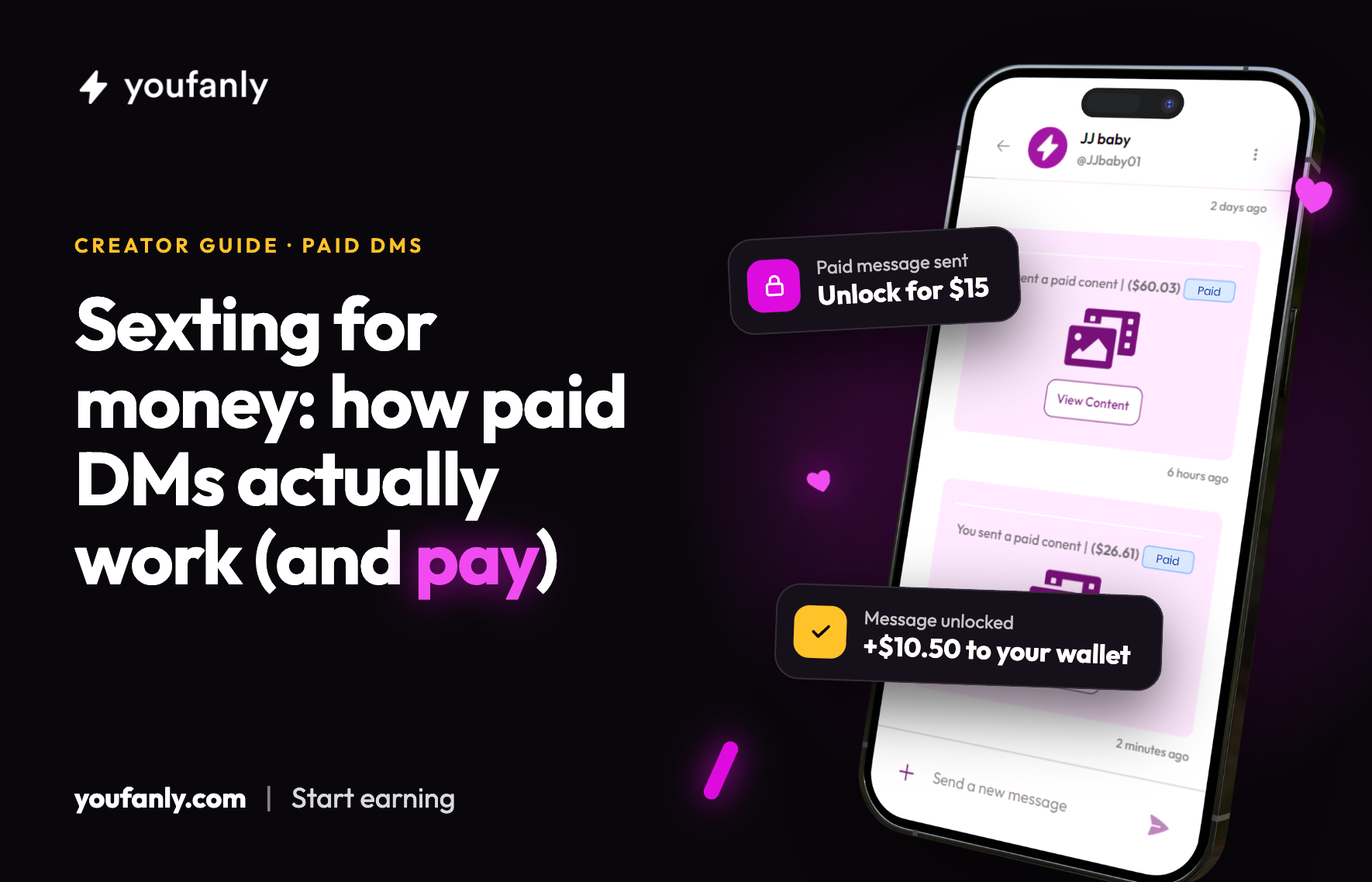
    In practice, a creator sets a price to open a paid conversation or to unlock a reply; the fan pays before the message is sent, and the platform handles the transaction so neither side has to negotiate payment mid-conversation. This is one of the features that pushed many creators to stop running everything manually through Telegram and Snapchat, where there is no built-in way to charge for a reply and every payment has to be chased down separately.

    Pricing a Conversation, Not Just a Photo

    The creators who do well with paid DMs treat them the same way successful creators treat turning a one off content sale into a repeatable system. Instead of guessing a price per message, they decide in advance what a short exchange costs, what a longer one costs, and what counts as premium versus standard attention.

    A few patterns that tend to work well:

    • Set a flat price to open a paid conversation, separate from the price for a subscription
    • Charge more for video messages than plain text, since they take more time and feel more personal
    • Decide your response time in advance so fans know what they are paying for, not just that they paid
    • Treat regular paying fans differently from one time spenders, since repeat conversations are where the real income builds

    Underpricing is the most common mistake. A paid conversation that is priced like a tip rather than like a product trains fans to expect your time for almost nothing.

    Letting Fans Know Paid DMs Exist

    Paid conversations do not sell themselves. Fans need to actually know the option exists before they will pay for it. A line in a bio, a mention in a free post, or a quick reminder sent to new subscribers all work better than hoping a fan stumbles onto the feature on their own.

    The framing matters as much as the mention. Treat a paid conversation as a genuine offer, not an upsell squeezed into every reply. Fans respond to it the same way they respond to any other part of a creator’s page: with interest when it feels natural, and with annoyance when it feels forced into a conversation they did not ask to be sold in.

    Keeping It Sustainable and Safe

    Paid DMs are personal by design, which means boundaries matter more here than almost anywhere else on a creator’s profile. A few basics are worth deciding before the first paid message, not after a fan pushes past them.

    • Decide what topics and requests are off limits, and say no without explanation when a fan crosses that line
    • Keep a separate name, email, and phone number for your creator account, the same way you would for any other part of your business
    • Use a platform with watermarking and leak reporting tools, since private messages can still be screenshotted and shared
    • Stay faceless if that is more comfortable. Plenty of creators build strong paid DM income through text alone

    These are the same fundamentals covered in the full guide to starting as an adult content creator, and they apply just as much to a paid conversation as they do to a posted photo.

    Where Paid Conversations Fit Into What Creators Actually Earn

    Subscriptions bring in steady, predictable income. Tips and paid DMs are where the ceiling opens up, because they scale with how connected a fan feels rather than how many fans a creator has. Real income data on adult content creators shows that diversifying beyond a single subscription price is one of the clearest differences between creators who earn modestly and creators who earn significantly more from the same size audience.

    On Youfanly, tips and paid conversations are not taxed the way platform commissions usually work elsewhere. Creators keep 100 percent of every tip and every paid message, with payouts available in local currency, mobile money, or crypto, and most withdrawal requests processed within 24 to 48 hours.

    Frequently Asked Questions

    Is sexting for money the same as camming? No. Camming is live and visual. Paid sexting happens through text or short video messages, usually asynchronously rather than in real time.

    Do I need to show my face to do this? No. Many creators build strong paid DM income through text alone, without ever showing their face.

    How much should I charge per message? There is no single right number. Start by pricing a short text reply lower than a video message, then adjust based on what your regular fans are actually willing to pay.

    What if a fan asks for something I am not comfortable with? Decide your limits in advance and say no without over-explaining. A platform built for this should make it easy to end or block a conversation without losing the income from the rest of your fans.

    Is paid sexting legal? Between consenting adults, generally yes. It becomes illegal when a minor is involved or when messages are used to harass, stalk, or threaten someone. Laws vary by location, and this is not legal advice.

    Conclusion

    Paid DMs are not a side feature. For creators who price them properly, set clear boundaries, and treat them as a real product instead of an afterthought, paid conversations often end up among the highest-earning things on their profile, not the lowest.

    Ready to turn your conversations into income instead of unpaid labor? Become a creator on Youfanly and start pricing your time the way it is actually worth.

  • How Much Do Adult Content Creators Actually Earn?

    How Much Do Adult Content Creators Actually Earn?

    Scroll through enough success stories online, and you would think every adult content creator is pulling in six figures by their third month. New car, new apartment, new life, all before the honeymoon phase of the algorithm even wears off. That story sells courses, agency contracts, and hype. It does not match the data.

    Here is what the actual numbers say. Most creators earn far less than the headlines suggest, a small percentage earn an extraordinary amount, and the single biggest reason for that gap has almost nothing to do with luck. It comes down to a handful of decisions any creator can actually control, including one decision that quietly determines how much of your own money you get to keep before you even see it. This article breaks down the real income data, why the earnings gap is so wide, and exactly what moves the needle if you want to end up closer to the top than the bottom.

    The Real Numbers Behind Adult Content Creator Earnings

    Industry data consistently points to the same uncomfortable truth. The average OnlyFans creator earns somewhere between 130 and 180 dollars a month, and this is not a typo. Roughly 70 percent of creators make less than 200 dollars a month, which means the vast majority of people who sign up never come close to replacing a full-time income.

    The top of the distribution tells a completely different story. The top 1 percent of creators earn an average of about 4,300 dollars a month, close to 52,000 dollars a year, while the top 10 percent of creators capture roughly 73 percent of all platform revenue, leaving the remaining 90 percent of creators splitting the last 27 percent between them. At the most extreme end, the top 0.1 percent of creators earn an estimated 735,000 dollars a year, compared to a median closer to 180 dollars for the typical creator.

    That is not a small gap. That is a completely different business model happening on the exact same platform.

    Why the Gap Between Top Earners and Everyone Else Is So Wide

    It is tempting to assume the top earners simply got lucky or started with a huge following. In reality, the gap almost always comes down to a specific set of habits and decisions, not luck, and definitely not talent alone.

    Consistency separates hobbyists from professionals. Creators who post sporadically rarely build the kind of trust that turns a subscriber into a long-term fan. Consistent posting, even simple content, consistently outperforms occasional high-effort content.

    Engagement multiplies earnings per subscriber; it does not just add to them. Data on subscriber value shows creators with high engagement can earn two to three times more per subscriber than creators with the same follower count but weaker fan relationships. A thousand passive followers earn far less than three hundred fans who feel personally connected to you.

    Niche shapes your ceiling before you even post your first photo. Certain niches carry naturally higher demand and lower competition, which changes what a subscriber is willing to pay before marketing even enters the picture.

    Revenue mix matters more than most new creators realize. Subscriptions alone rarely build high income. Pay-per-view content and tips, used strategically with an engaged audience, often make up a large share of what top earners actually collect each month.

    What Actually Determines How Much You Earn

    If you strip away the noise, five factors explain most of the variation in creator income.

    1. How consistently you post and show up for your audience
    2. How personally connected your fans feel to you, not just how many of them there are
    3. Which niche you choose and how clearly you define it
    4. Whether you diversify income through subscriptions, pay-per-view content, and tips instead of relying on one stream alone
    5. How much of your gross earnings your platform actually lets you keep

    That last factor is the one almost nobody talks about, and it might be the single most controllable lever in this entire list.

    Gross Earnings vs What You Actually Keep

    This is where most creators lose money without ever realizing it. When people quote OnlyFans income statistics, they are almost always quoting gross earnings, the total amount fans pay before the platform takes its share. OnlyFans charges a flat 20 percent commission on every dollar earned, which means a creator technically earning 1,000 dollars in fan spending only receives 800 dollars before taxes and any other costs.

    Now stack an agency fee on top of that, which is common for creators who want help scaling. Depending on the agency, that can mean handing over another 30 to 50 percent of what remains, leaving a creator with a fraction of what their fans actually paid.

    This is exactly why platform choice belongs at the top of your income strategy, not as an afterthought. Youfanly’s structure looks different from OnlyFans in one important way. Creators keep 70 percent of subscription revenue and 100 percent of every tip, with no agency layered on top to take a further cut. Tips matter more here than the headline number suggests, since they often make up a meaningful share of a top earner’s total income once fan relationships are strong. If a fan sends a 100 dollar tip on OnlyFans, the platform’s flat 20 percent commission takes 20 dollars of it before the creator ever sees the money. The same 100 dollar tip on Youfanly arrives in full. Payouts also land in local currency, mobile money, or crypto, which matters enormously for creators who have previously lost income to currency conversion fees elsewhere.

    A Realistic Income Timeline for New Creators

    Earnings rarely arrive in a straight line, and setting realistic expectations early helps you avoid quitting right before momentum builds. A commonly cited growth pattern for new creators looks roughly like this.

    • Months 1 to 3, most creators earn between 0 and 500 dollars while building their first real audience
    • Months 4 to 6, consistent creators typically move into the 200 to 1,500 dollar range as retention starts to compound
    • Months 7 to 12, established creators often reach 500 to 4,000 dollars a month as their fan relationships mature
    • Year two and beyond, income becomes highly variable, shaped almost entirely by niche, consistency, and how well fan relationships have been maintained

    The pattern is consistent across most documented creator income timelines. The people who quit in month two are almost always quitting during the slowest, least representative stretch of the entire journey.

    How Niche Affects Earning Potential

    Not every niche earns the same amount for the same amount of effort. Industry data on niche performance shows meaningful gaps between categories, with certain specialized niches earning two to three times more per subscriber than more generalized content. Creators who pick a clearly defined niche and stay consistent within it tend to out-earn creators who try to appeal to everyone at once, even when their content quality is similar.

    This is part of why niche selection deserves real thought before you post your first piece of content, rather than being an afterthought you figure out later.

    Yes, Men Earn Well In This Space Too

    Earnings data confirms that this is not an income opportunity limited to one gender. Reporting on the space has noted that male creators often earn strongly in niches like LGBTQ content and male fitness modeling, where demand is high, and competition among creators is comparatively lower. The strategies in this article, from niche selection to engagement to platform choice, apply the exact same way regardless of gender.

    How Youfanly Changes the Math

    Everything above points to the same conclusion. The creators who earn the most are not necessarily the most talented; they are the ones who treat this like a business, stay consistent, build real fan relationships, and choose a platform that does not quietly eat into their income.

    Youfanly was built around that last point specifically. Creators keep 70 percent of subscription revenue and 100 percent of every tip, so the fan relationships you build through personal connection translate more directly into income you actually keep. Sign-up is also far simpler than most competitors. Where OnlyFans reportedly approves only about 36 percent of creator applications, Youfanly lets you start earning as soon as you sign up and submit your account, so you are not stuck waiting weeks to find out if you can even begin. The results are already visible. Youfanly closed out its first year with over 35,000 users and more than 450 million naira, about 312,000 dollars, paid out to over 4,500 creators across Nigeria, Ghana, South Africa, Kenya, Tanzania, and the United States, a milestone also independently reported, with many withdrawal requests processed in under an hour and payouts available in local currency, mobile money, or crypto. When fan connection and tips genuinely translate into income, the same effort simply produces more.

    Frequently Asked Questions

    How much does the average adult content creator actually make? Most creators earn a modest amount, commonly cited between 130 and 180 dollars a month, while a small percentage of top earners make significantly more through strong engagement, consistent posting, and diversified income streams like pay-per-view content and tips.

    Why do some creators earn so much more than others? The gap usually comes down to consistency, how personally connected fans feel to the creator, niche selection, and how much of the gross income the platform allows the creator to keep after fees.

    How long does it take to start earning meaningful income? Most creators see their first real growth between months four and six, with more substantial income typically building between months seven and twelve as fan relationships mature and content libraries grow.

    Do platform fees really make that much of a difference? Yes. A flat 20 percent platform commission on 1,000 dollars in fan spending means losing 200 dollars every single month before taxes or any other costs. Over a year, that adds up to a significant amount of lost income that a creator never actually gets to keep.

    How does Youfanly’s earnings split work? Creators keep 70 percent of subscription revenue and 100 percent of every tip, with payouts available in local currency, mobile money, or crypto. Sign-up is simple, and creators can start earning as soon as their account is submitted.

    Does niche affect how much I can earn? Yes, meaningfully. Certain niches see stronger demand and higher spending per subscriber, so choosing a clear, well-defined niche tends to outperform trying to appeal to a broad, undefined audience.

    Can men make good money as adult content creators too? Yes. Male creators build high incomes in this space, particularly in niches where demand is high, and creator supply is comparatively lower. The core strategies for growing income apply the same way regardless of gender.

    Conclusion

    The real earnings data tells a clear story. Most creators earn modestly, a small percentage earn extraordinary amounts, and the difference almost always comes down to consistency, fan connection, niche, and how much of your own income your platform actually lets you keep. That last factor is fully within your control the moment you choose where to build.

    Ready to keep more of what you earn, starting with every tip. Sign up at youfanly.com and start building your income on a platform designed to help you keep it.